
Psychoeducation & Clinical Series | Written for High-Functioning & Deep-Thinking Clients

In her hit song "good 4 u," Olivia Rodrigo captures a very specific kind of emotional whiplash. She sings about the jarring shock of watching an ex move on seamlessly while you are left sitting with the wreckage of your own dysregulated nervous system:
"Well, good for you, I guess you moved on really easily"
"You found a new girl and it only took a couple weeks"
"Remember when you said that you wanted to give me the world?"
"I've lost my mind, I've spent the night crying on the floor of my bathroom...
(Olivia Rodrigo, "good 4 u")
Beneath the track's energetic pop-punk production lies an experience anyone who has invested deeply in another person recognizes. It is the shock of seeing how effortlessly someone else can detach, pivot, and step into their next chapter.
The Gentle, "Amicable" Heartbreak Is Still Crushing
It is worth naming that this emotional whiplash doesn't only happen in angry, bitter breakups.
Sometimes, the ending is entirely amicable. The person is polite, kind, and respectful. You might even stay on good terms or remain friends. But in many ways, that quiet, gentle split can feel even more disorienting.
When there is no clear villain to be angry at, your brain doesn't know where to direct its grief. Watching someone be "nice" while calmly stepping away from a shared future still leaves you holding the heavy weight of unfulfilled hope. The pain isn't always about malice; often, it is simply the crushing gap between how deeply you cared and how easily the other person was able to let go.
Whether the split was volatile or gentle, culture expects you to download an app, curate a fresh profile, and act completely unbothered.
It becomes an underlying grief.
Starting Over Is Exhausting
When a connection dissolves, it hurts in a very physical way.
Starting over requires immense energy. It takes courage to open yourself up, imagine a shared future, and trust someone. When that evaporates, the prospect of going through the exact same introductory small talk over dinner with a stranger feels utterly draining.
Then comes the quiet, sinking fear that knocks the wind out of you: What if I never find my person? What if I never find the real thing?
Part of you isn't even looking for a grand romantic gesture. You just pragmatically dread getting back on an app, while aching with the simple, stubborn wish that the thing you wanted so badly hadn't turned out this way.
You are not just sad about one person. You are tired of the cycle. Grieving an imagined future takes time, and trying to force yourself to feel ready when your body is begging for rest only digs the hole deeper.
The Biology of Heartbreak: Why Your Stomach Hurts & Your Mind Loops
If you have experienced a deep, sickening "pit in your stomach" or a physical ache in your chest during a breakup, you are not imagining it. Heartbreak is a visceral, biological event:
The Gut-Brain Axis & The "Pit" in Your Stomach: When emotional rejection or loss hits, your brain's alarm system floods your system with stress hormones like cortisol and adrenaline. Your gastrointestinal tract is lined with millions of nerve cells. When adrenaline surges, it diverts blood flow away from digestion toward your muscles. This sudden drop in blood flow and muscle contraction in your gut creates that heavy, sickening aching sensation.
Dopamine Withdrawal: Being closely connected to someone provides steady levels of dopamine. When that bond is abruptly severed, your brain experiences a sharp drop in dopamine signaling—resembling a physical withdrawal state. Because dopamine helps regulate pain perception, a sudden crash lowers your pain threshold, making emotional distress feel acutely physical.
Why Your Mind Keeps Asking "Where Did I Choose Wrong?": To cope with this physical distress, your brain's prefrontal cortex kicks into overdrive through a process called causal attribution search. Your brain hates ambiguity because ambiguity feels unsafe. By replaying past conversations and asking "Where did I choose wrong?" or "What if I had asked for less?", your brain is desperately trying to find a variable it can control.
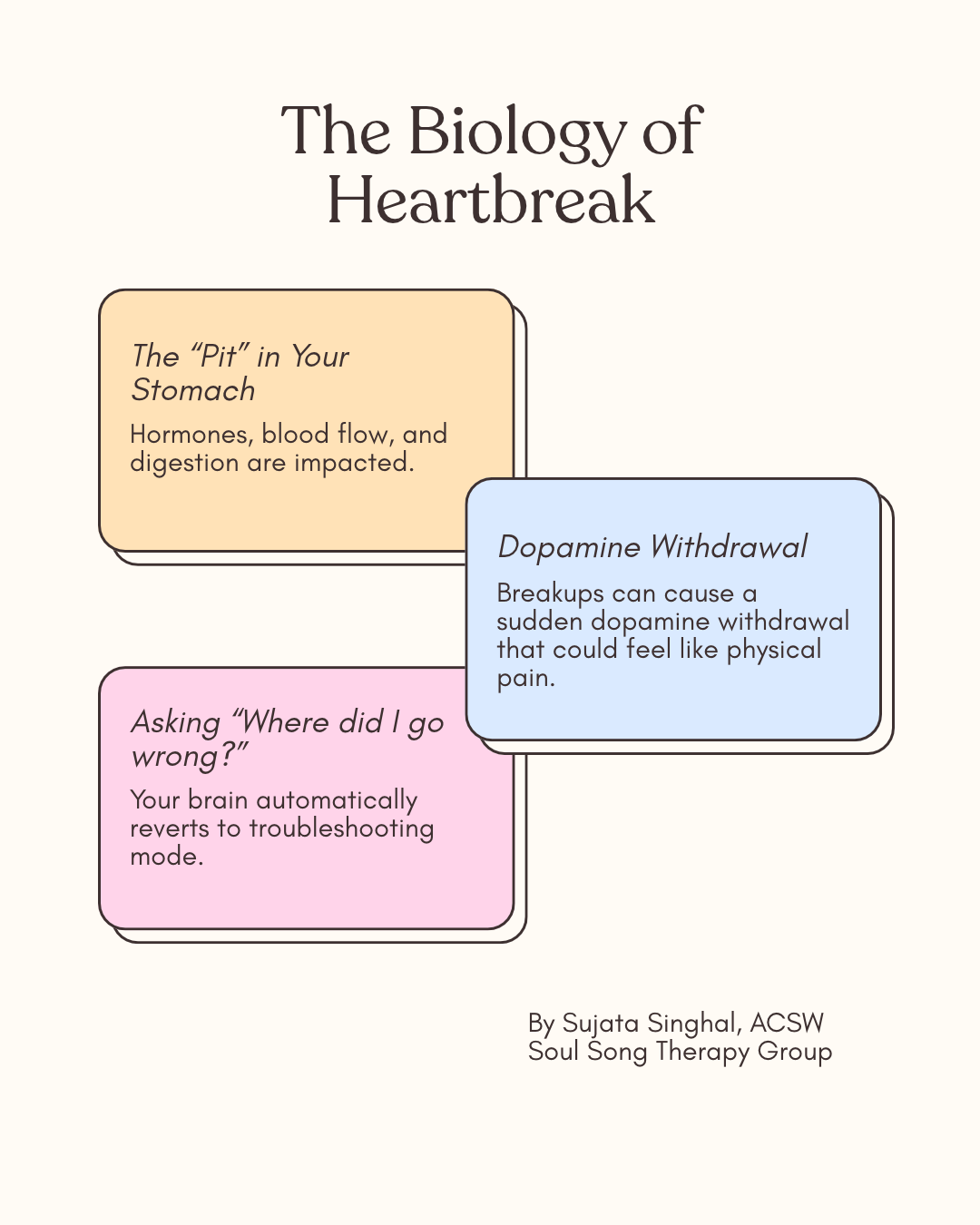
Heartbreak has a major physical impact.
Analyzing the past gives your mind a false sense of agency—tricking you into believing that if you can pinpoint your "mistake," you can guarantee safety in the future.
The catch is that you cannot think your way out of grief.
When disappointment isn't acknowledged, it usually splits into two directions: anxiety (where you are constantly hypervigilant and terrified to hope) or depression (where you go numb because caring feels too risky).
Real Acceptance (Not Giving Up)
Working through relational disappointment does not mean pretending everything is fine, and it definitely does not mean resigning yourself to being alone forever.
It starts with honest acceptance.
Acceptance is not defeat; it is simply ending the internal argument with reality. It is looking at things clearly and saying: I really loved that person, but they did not have what it takes to give me what I need. Or: Even though they are a good person, this connection does not have a future, and holding on to potential is destroying my peace.
When you stop wasting bandwidth wishing things were different than they are, your nervous system finally begins to settle.
A Nuanced, Whole-Person Approach to Healing
Healing from deep relational grief isn't a linear, one-size-fits-all process. It isn't just about changing your thoughts or repeating positive mantras. It requires an integrative approach that honors your body, your mind, and your soul:
Allowing the Initial Pain (Without Getting Stuck): Pain is a natural biological response to loss. Trying to bypass or intellectualize the hurt only traps it in your body. Suffering through the initial waves of grief—with safety and support—is what allows the emotion to move through you rather than keeping you stuck.
Radical Self-Compassion: Giving yourself permission to stop rushing your timeline. Honoring physical fatigue, nausea, and sadness without forcing yourself to turn every pain into an immediate "life lesson."
Somatic & Nervous System Regulation: Learning how to calm your gut-brain axis through breathwork, warmth, and grounding practices so your body learns that it is safe, even in the midst of heartbreak.
Cognitive & Relational Reframing: Working through protective mental loops, untangling self-blame, and shifting from "What is wrong with me?" to "How did my system learn to over-function in love?"
Supportive Psychotherapy: Engaging in a safe space where you can process attachment patterns, build emotional regulation, and realize you do not have to carry this weight alone.
One of the most beautiful aspects of the human mind, heart, and soul is that once we drop the illusion of control and get in touch with our true feelings, we discover we are not alone. Countless deep thinkers walk this exact same path, and with time, space, and guidance, genuine connection becomes possible again.
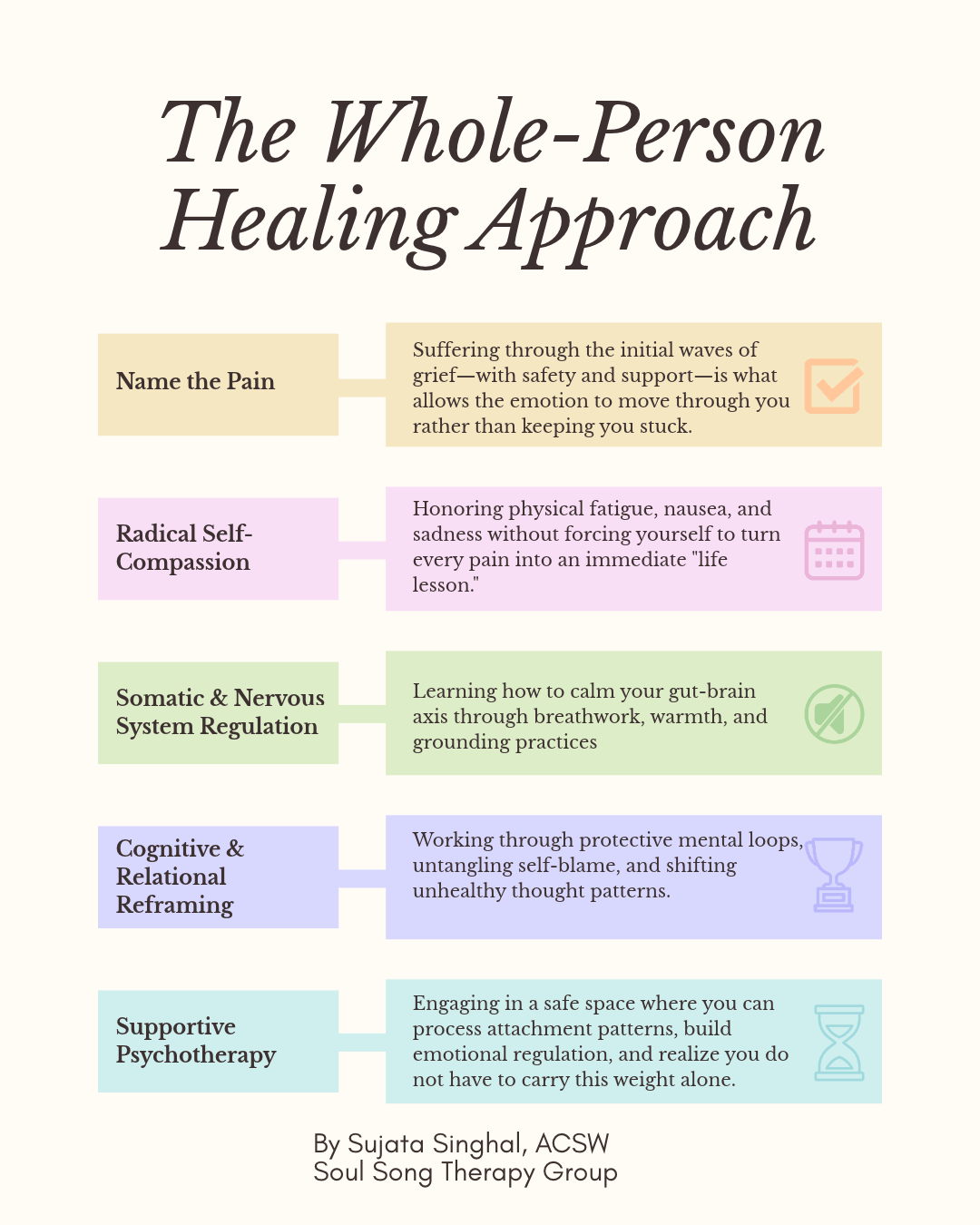
Healing from heartbreak engages more than just your thoughts and feelings.
What Sitting Down With Me Looks Like
Hi, I’m Sujata, an Associate Clinical Social Worker (ASW).
In my practice, I work with individuals—whether you are currently in a relationship, navigating a breakup, single, or figuring out your next steps—as well as couples and teens. My clients range from high-functioning professionals and first-generation adults carrying heavy systemic expectations, to simply deeply empathetic people who naturally feel things intensely and struggle to carry the weight of it all.
When you are stuck inside your own head, it is hard to tell healthy emotional processing apart from running in mental circles. In our sessions, we create a space that is warm, direct, fast-paced, and collaborative:
Connecting Mind and Body: We pay attention to both the cognitive loops in your head and the physical signals in your body—like that sickening pit in your stomach. We bring in real-time grounding to help your nervous system settle naturally when emotional waves hit.
Matching Your Speed: If your mind moves fast and analyzes constantly, I meet you right at that pace. At the same time, we know when to slow down so your nervous system gets a genuine chance to rest.
Quelling the Rumination: When you get caught replaying the past, over-analyzing conversations, or looping on self-blame, we pause. We take a breath, often write things down right there in the room, and untangle those repetitive thoughts with clarity.
Rebuilding Your Anchor: Drawing from cognitive reframing, emotion regulation, and parts work, we help unburden the protective parts of you that tend to over-function in love. We build a sense of self strong enough to handle relational risk, so your self-worth isn't dependent on someone else's ability to choose you.
Getting Your Energy Back
You do not have to fake an upbeat attitude to heal from disappointment. You do not have to pretend you are unbothered, or act like you're glad things turned out the way they did.
Sometimes the most productive thing you can do is simply let yourself feel disappointed for a minute without rushing to fix it.
When you stop burning all your energy trying to look fine, your nervous system finally gets the hint that it is allowed to power down. The constant hum of tension drops. The mental chatter slows down.
And once you have some solid ground beneath your feet again, the genuine curiosity and capacity for connection you thought you lost can finally start to show back up.
Ready to Talk?
If you spend an enormous amount of mental energy keeping life running while quietly carrying relational loss, you do not have to navigate it alone.
Whether you are healing from a relationship ending, exhausted by dating, or navigating complex family dynamics, you deserve a space where you do not have to perform.
Reach out today to schedule an initial consultation, and let us start sorting through it together.